Toxic Combinations
Tenable One Cloud Exposure searches for potential toxic combinations in your environment. Some, or all, of these combinations may appear in the Toxic Combinations dashboard widget.
This article provides an in-depth look at several toxic combinations across cloud security domains. Each example breaks down the individual risks associated with each component, along with the heightened threat they pose when both elements are present simultaneously. Additionally, you can see a list of all toxic combinations in the platform.
- Workload Protection:
- Data Protection:
- CIEM (IAM Governance):
- CSPM / CIEM:
What Is a Toxic Combination?
In cloud security, a toxic combination is a set of permissions, attributes, or conditions that together create a bigger security risk than each would pose on its own. These combinations often enable users to bypass security controls, perform unauthorized actions, or access sensitive data without proper oversight. Identifying and managing toxic combinations is essential for enforcing least privilege and preventing privilege escalation or unauthorized access in cloud environments.
For example, a toxic combination might consist of a guest user with high privileges, because a user account intended for minimal, limited access was granted extensive access, which can lead to accidental or intentional misuse and other security incidents.
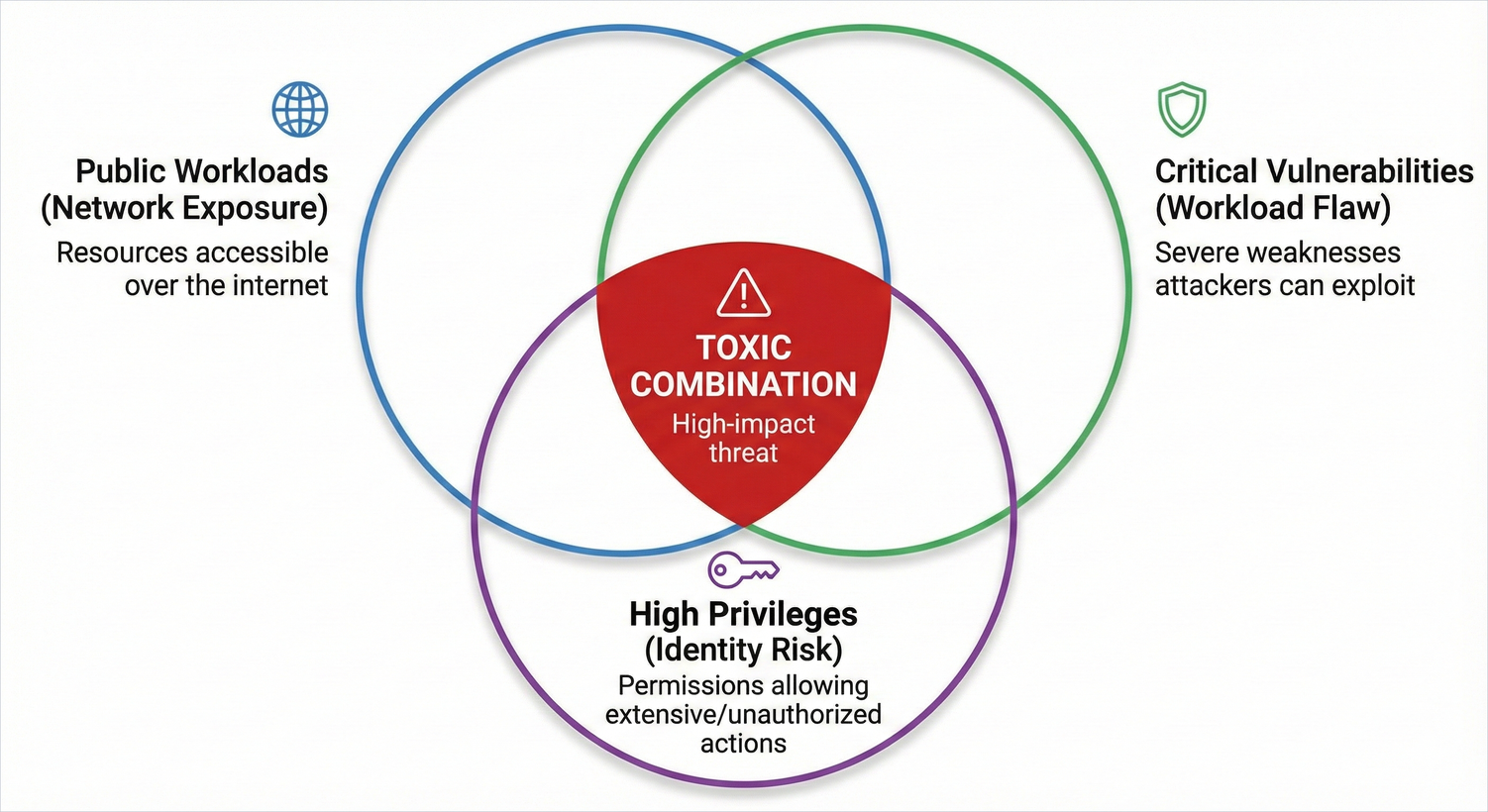
Public Workloads with Critical Vulnerabilities and High Privileges
- Public workloads:
- Description: Workloads that are accessible over the internet.
- Risk: Increased exposure to attackers who can scan and target these resources.
- Critical vulnerabilities:
- Description: Severe security weaknesses that attackers can exploit.
- Risk: An attacker could use these vulnerabilities to compromise the workload.
- Combined risk:
- If an attacker exploits the vulnerability, high privileges can allow unauthorized control over sensitive systems, escalating the impact of the breach.
Public Data Resources with Sensitive Data
- Public data resources:
- Description: Storage or data repositories open to the internet.
- Risk: Exposes data to anyone with internet access, increasing risk of unauthorized viewing or theft.
- Sensitive data:
- Description: Information that should be kept confidential, such as PII or financial data.
- Risk: Disclosure of sensitive data can lead to compliance issues, reputation damage, and financial loss.
- Combined risk:
- Publicly exposed sensitive data is highly attractive to attackers and significantly raises the potential for data breaches and misuse.
External Principal with High Privileges
- External principal:
- Description: An external user or entity (e.g., contractor or partner) given access to a cloud environment.
- Risk: External users are harder to monitor and control, increasing the risk of data misuse.
- High privileges:
- Description: Permissions that allow extensive access and actions within the environment.
- Risk: High privileges can enable wide-ranging access, including potentially sensitive resources.
- Combined risk:
- An external principal with high privileges could inadvertently or intentionally access or manipulate critical data, posing risks to internal controls and data security.
Public Functions with High Privileges
- Public functions:
- Description: Serverless functions or APIs exposed to the internet.
- Risk: Public functions can be accessed by anyone, increasing the likelihood of attacks.
- High privileges:
- Description: Elevated permissions for executing sensitive tasks or accessing restricted resources.
- Risk: If compromised, high privileges can enable extensive unauthorized actions.
- Combined risk:
- A public function with high privileges offers attackers a direct path to high-impact actions if they successfully exploit the function, bypassing other security controls.
List of Toxic Combinations
Cloud Exposure searches for the following potential toxic combinations in your environment. Some, or all, of these combinations may appear in the Toxic Combinations dashboard widget.
- 3rd party identity with access to sensitive data
- App engine service with critical vulnerabilities and high privileges
- Cloud run service with critical vulnerabilities and high privileges
- ECS service with critical vulnerabilities and high privileges
- External principal with high privileges
- External principals with access to sensitive data
- Guest user with high privileges
- Guest user access to sensitive data
- IAM user with no MFA and high privileges
- Public cloud run service with critical vulnerabilities / high privileges
- Public data resources with sensitive data
- Public data resources without encryption at rest
- Public storage accounts with shared key access
- Public ECS service with critical vulnerabilities / high privileges
- Public functions with high privileges
- Public virtual machine with high privileges
- Public workloads with critical vulnerabilities / high privileges
- Public workloads with an OS that is at or nearing EOL
- Public workloads with an unpatched OS / high privileges