Secrets
The Secrets page lists all instances of secrets that Tenable One Cloud Exposure finds in your cloud configurations, such as environment variables, tags, and startup scripts.
A secret instance is an occurrence of one secret in one specific location, like a particular API key found in a specific environment variable. You can have multiple instances of the same secret.
To open the page, in the Cloud Exposure console, click Explore > IAM > Secrets.
Note: This feature is currently in Public Preview. To learn more about the intent behind preview releases and what to expect during this phase, see Public Preview Overview.
Note: The page currently lists secret instances found in cloud configurations. Secrets found inside the content of data resources, such as databases, buckets, and files, are not included yet.
Secrets Overview
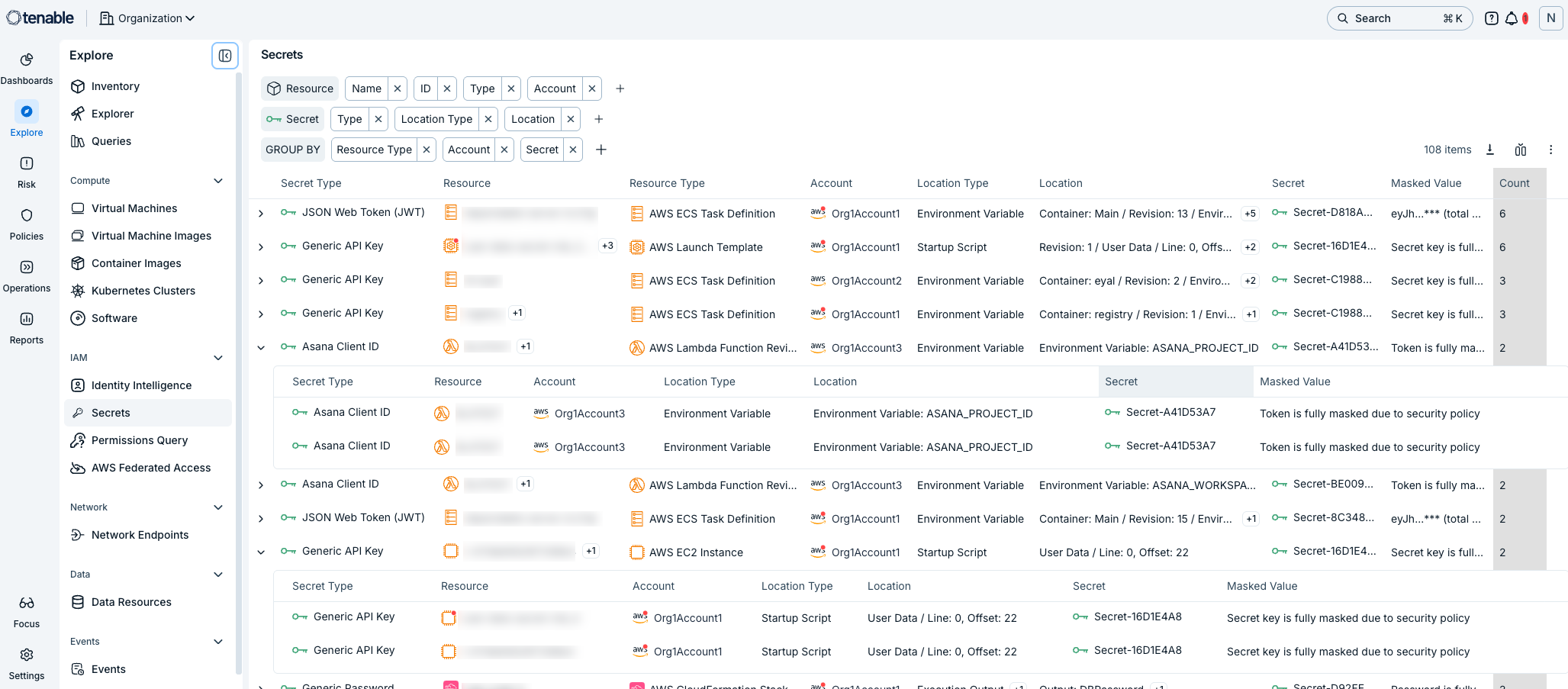
The Secrets page includes these areas:
| Area | Description |
|---|---|
| Filters | Filter the table by the conditions on the resource or secret. Click the plus icon to add more filters. |
| Group by | Select how to group secret instances. By default, secret instances are grouped by Resource Type, Account, and Secret. |
| Secrets table | Lists secret instances grouped by secret type. Expand a secret type group to see its secret instances. See Secrets Table. |
Secrets Table
The Secrets table includes these columns. Expand a group to see all secret instances for that type. When grouped, some columns can have multiple values.
| Column | Description |
|---|---|
| Secret Type | The type of secret, such as Amazon Bedrock API Key, Data Bricks API Token, or Slack Webhook URL. |
| Resource | The name of the resources that hold the secret. |
| Resource Type | The type of resources that hold the secret, such as AWS EC2 Instance, AWS CloudFormation Stack, or GCP Storage Bucket. |
| Account | The cloud account that contains the resource with the secret. |
| Location Type | The kind of place within the resource where the secret was found, such as Environment Variable, Tag, Startup Script, Execution Output, or Execution Parameter. |
| Location | The exact location of the secret in the resource, such as the environment variable name, container, and revision. |
| Secret | The ID of the secret, such as Secret-D818A92F. The same secret has the same ID wherever it appears. |
| Masked Value | The secret value with part of it hidden. Masking depends on the secret type. For example, a JWT shows its first characters and total length. |
| Count | The number of secret instances in the group. |