How Compliance Works
Tenable One Cloud Exposure helps you monitor your cloud environment's adherence to various compliance standards through a robust assessment process. Understanding how these assessments work is key to effectively managing your compliance posture.
This is a conceptual overview of how compliance assessment works. For a how-to guide about monitoring compliance see Compliance.
Benchmark Guidelines and Policy Mapping
Compliance in Cloud Exposure is based on industry-recognized benchmark guidelines from various standards such as CIS, AWS Well-Architected, GDPR, and more. These benchmarks define security configurations and best practices. Tenable then translates these guidelines into specific policies. Each policy acts as a granular check, assessing your cloud resources against a particular benchmark.
CIS Benchmarks
CIS benchmarks are an excellent starting point for measuring your organization's compliance posture. You can use them out-of-the-box in Cloud Exposure to compare compliance scores for your cloud projects/accounts, or integrate them with your overall compliance policy.
Tenable focuses on aligning settings with desired configurations, providing a baseline for strong security. While CIS recommendations are not assigned severities for prioritization directly, CIS does facilitate prioritization by dividing its benchmarks into levels:
- Level 1 covers essential recommendations
- Level 2 (and sometimes 3) covers more stringent security configurations.
Manual vs. Automated Recommendations
CIS Benchmark recommendations include an assessment status that represents whether a CIS Benchmark recommendation can evaluate an environment state with an automated check or whether it requires manual investigation. Respectively, CIS Benchmarks label each recommendation as either manual or automated:
- Manual — Requires manual steps to determine whether the environment's configured state is as expected. You cannot automatically achieve a pass/fail assessment result. While Cloud Exposure generally cannot support manual recommendations due to technical complexities, partial coverage may be available in certain cases.
- Automated — The environment state can be automatically evaluated against the recommended state with a configuration assessment tool. You can automatically achieve a pass/fail assessment result.
See the CIS website for more information.
Understand Compliance Scores
The compliance score represents the percentage of resources that passed policy benchmarks:
- Overall standard score — The overall standard's percentage is calculated by averaging the percentages of all related individual requirements.
- High-level requirements score — Similarly, for any high-level requirements (which group several individual requirements), the percentage is calculated by averaging the percentages of all individual requirements under that specific high-level requirement.
- Individual requirements score — Individual requirements' percentages are calculated by averaging the percentages of all policies related to the requirement.
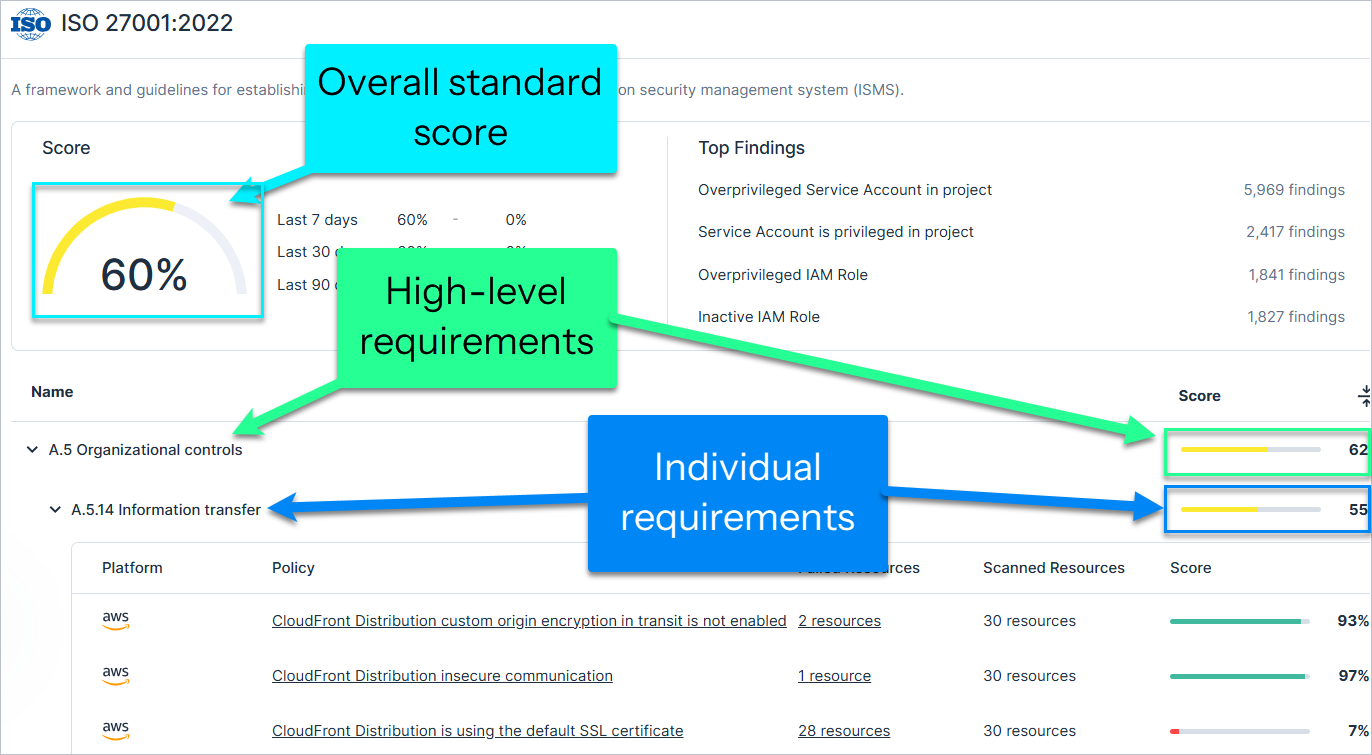
A score of 100% can indicate that:
- All resources passed the requirement (0 failed).
- No resources were scanned.
In the following situations, an individual requirement isn't taken into account for the compliance score:
-
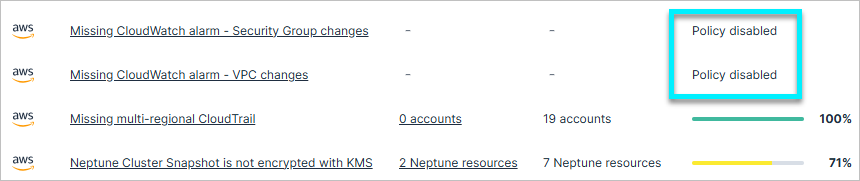
If a policy is disabled
-
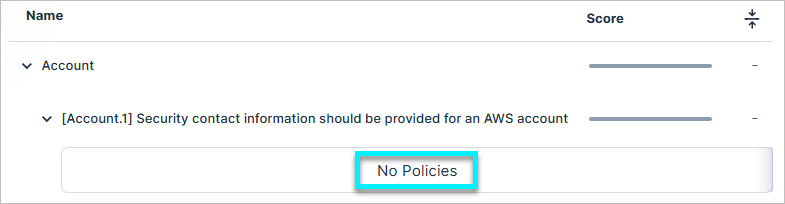
If there is no policy mapped to an individual requirement
Example: Calculating Compliance Scores
The following example illustrates how compliance scores are calculated based on simple averages at different levels of detail.
-
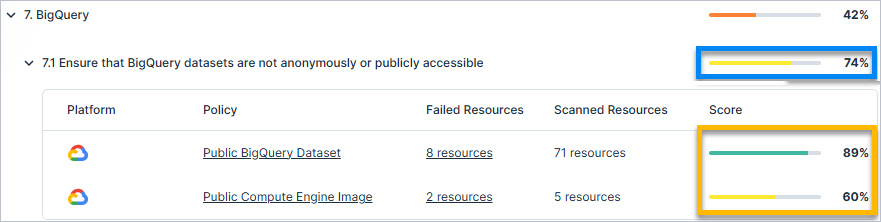
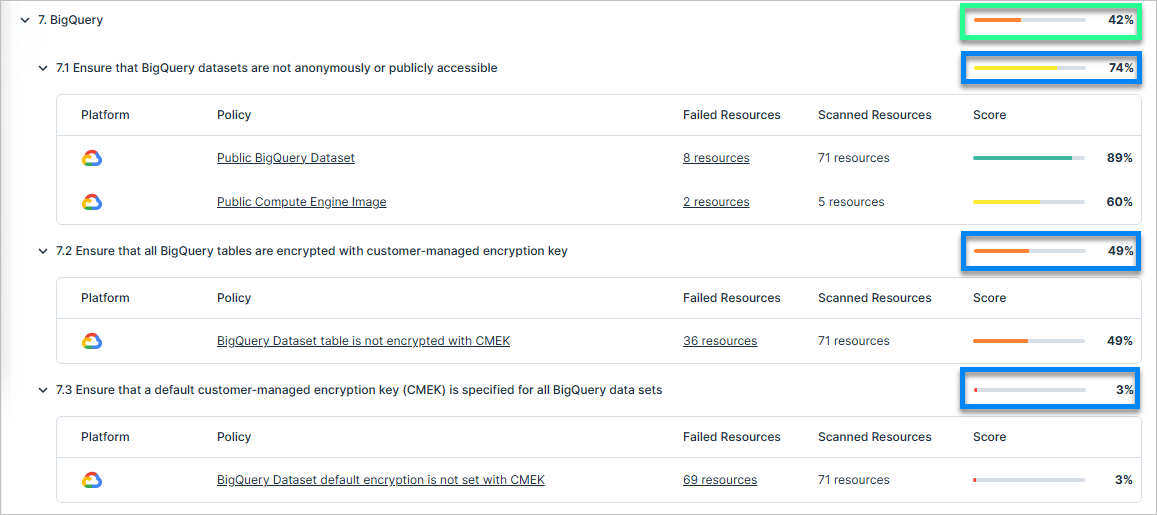
Individual Requirement Score Calculation. The individual requirement score is determined by averaging the percentages of all policies related to it.
-
Example: 7.1 Ensure that BigQuery datasets are not anonymously or publicly accessible
Policy Name Score Public BigQuery Dataset 89% Public Compute Engine Image 60% - Calculation for individual requirement:
(89% + 60%) / 2 = 149% / 2 = 74.5% ≈ 74%
-
-
High-Level Requirement Score Calculation. A high-level requirement's score is calculated by averaging the scores of all individual requirements that fall under it.
-
Example: 7. BigQuery (high-level requirement)
Individual Requirement Score 7.1 (BigQuery datasets not anonymous) 74% 7.2 (BigQuery tables encrypted with CMK) 49% 7.3 (Default CMK specified for BigQuery datasets) 3% - Calculation for high-level requirement:
(74% + 49% + 3%) / 3 = 126% / 3 = 42%
-
-
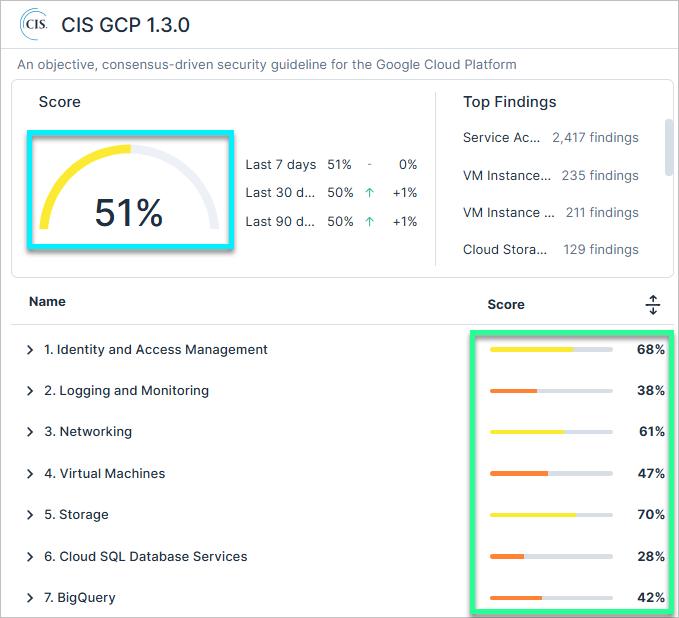
Overall Standard Score Calculation. The overall standard score is the average of all individual requirement scores across the entire compliance standard.
-
Example: CIS GCP 1.3.0 Standard
High-Level Requirement Score Identity and Access Management 68% Logging and Monitoring 38% Networking 61% Virtual Machines 47% Storage 70% Cloud SQL Database Services 28% BigQuery 42% - Calculation for overall standard:
(68% + 38% + 61% + 47% + 70% + 28% + 42%) / 7 = 354 / 7 = 51%
-