Container Images
This is a how-to guide for viewing and managing container images.
- For a conceptual overview of workload protection capabilities, see Vulnerability Management.
- To configure container registry settings, see Container Registry Settings.
- For frequently asked questions, see FAQ: Vulnerability Management.
View All Container Images
Required License: This feature is available with either the CSPM, Standard, or Enterprise license.
View all container images in your Tenable One Cloud Exposure environment.
To view container images:
- In the Cloud Exposure Console, navigate to Explore > Compute > Container Images.
- Filter the table to narrow the scope of the visible data. See Container Image Column Data for more information.
- Click on an image Name to View Resource Details.
-
From the resource page, click on Workload.
Note: Tenable-based scans provide additional context for container images that isn't available from scans performed by cloud providers. Container images scanned by Tenable have an additional Workload tab in the resource view, providing information about 1) software packages installed on the image, and 2) vulnerabilities detected on the image, along with relevant fixes. -
Click one of the following tabs:
- Software — View software packages installed on the machine.
- Vulnerabilities — View vulnerabilities associated with packages installed on the machine.
Run an On-Demand Scan
Cloud Exposure automatically scans every container image and container repository at least once every 24 hours. If you want to scan a specific workload sooner than that, you can request an on-demand scan. When you initiate a scan, it pushes the scan to the top of the queue. Scan results will appear in the Cloud Exposure Console after the next periodic data synchronization performed by Tenable.
- Container images — Scanning an image triggers a scan for that specific image, the 10 most recent images in the parent repository, and all images currently in use.
- Container repositories — Scanning a repository includes the 10 most recent images and all images currently in use within that repo.
To run an on-demand scan:
- Navigate to, and then click on the relevant virtual machine. You can find virtual machines in Explore > Compute > Virtual Machines, or in the Inventory view of the relevant cloud provider (for example, Explore > Inventory > Compute > Azure Virtual Machines).
-
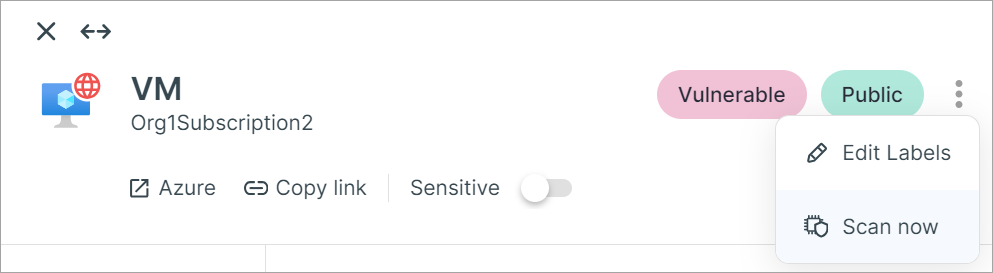
Click on the three dots icon and then click Scan Now.
A dialog appears, indicating that the scan was successfully requested.
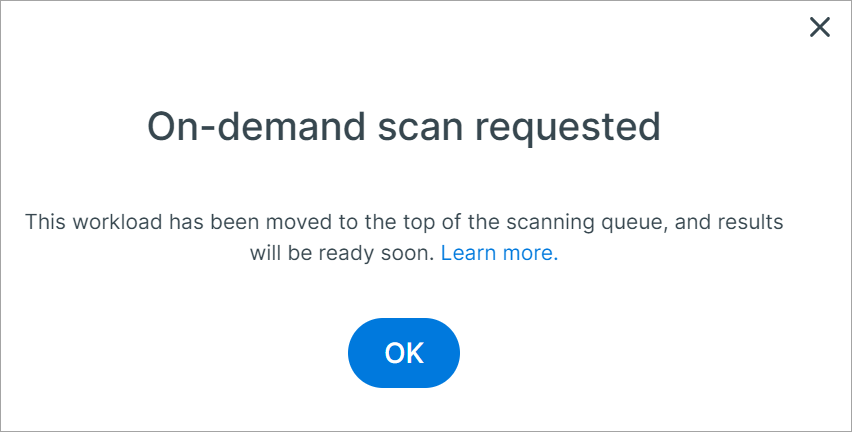
- Click OK.
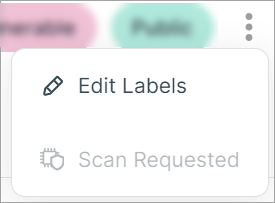
If a scan has already been requested, the button is disabled and displays Scan Requested.
Container Image Column Data
The following columns appear in the table on the Container Images page, and most of them can also be used to filter data in the table.
| Column | Description |
|---|---|
| Name | The name of the image. |
| Account | The cloud accounts associated with the image. An image appears under every account that runs it. Images pulled from registries you have not synced to Cloud Exposure (for example, docker.io or quay.io) appear under a single account named Container Registries. |
| Repository | A list of repository where the image is stored. |
| Image Tags | Tags assigned to the image. |
| Digest | The container image identifier (SHA256). |
| Image Labels | A list of Docker container labels for the image, listed by key:value. Labels with a key or value size greater than 5KB are not listed. |
| Creation Time | The timestamp that the image was created. |
| Clusters | The clusters that use the container image. |
| Virtual Machines | The virtual machines that use the container image. |
| Workloads | The workload to which the image is deployed. For example, a virtual machine, Kubernetes workload, or container service solution. |
| Operating System | The operating system and version running on the image. |
| Operating System Type | The specific operating system distribution of the image. |
| Software | A list of all software packages installed on the workload. Where relevant, you can also see the file path of the package. This information can be useful when trying to determine where the package came from, and how to remediate any potential issues. For example, you may be able to identify if the package was installed as part of the base image, or if it was added to it. |
| Vulnerabilities | A breakdown of vulnerabilities found on the workload by Color-Coded Risk Severity. Click on a number to view a list of vulnerabilities for a given severity level. |
| Findings | The number of findings associated with the identity. Click on the number to view a searchable list of the findings. |
| Plugins | The plugins that are associated with the vulnerabilities discovered on the image. Click the plugin link to view plugin details. |
| Scan Time | A timestamp indicating the last time that Cloud Exposure scanned the machine. If the machine has not yet been scanned, the value is a dash (-). |
| Labels |
Displays all labels applied to the image, whether applied manually, automatically based on tags, or by the system. Hover over a label tag for more information. If an image has more than one label, click on the icon to see any additional labels. The following labels are unique to Workload Protection, and are displayed in the following circumstances:
|
| Container Image Usage (filter only) | Indicates whether the scanned container image is being used by a workload. Possible values: Unused, Used. For more details, see the FAQ. |